Automate what genuinely doesn't need your attention
Pillar 3 of 5: Automate
If you’ve read the previous pieces in this series, you’ve been thinking about how AI can help you think better and write faster. This one is different. Automation isn’t about AI augmenting your judgement - it’s about removing the need for your attention on things that genuinely don’t need it.
Every PM I’ve worked with carries a version of the same list. Not the project plan, not the risk register - the other one. The tasks that happen on a schedule, follow the same steps every time, and produce something nobody would describe as your professional contribution. Chasing the same people for their status updates every fortnight. Copying action items from a meeting transcript into a tracker because the two tools have never spoken to each other. Reformatting an export before you can share it. Writing a summary email structurally identical to the one you sent last week.
None of these require you. That’s not a criticism - it’s the point. They just require that someone does them. And right now, that someone is you.
What automation actually is
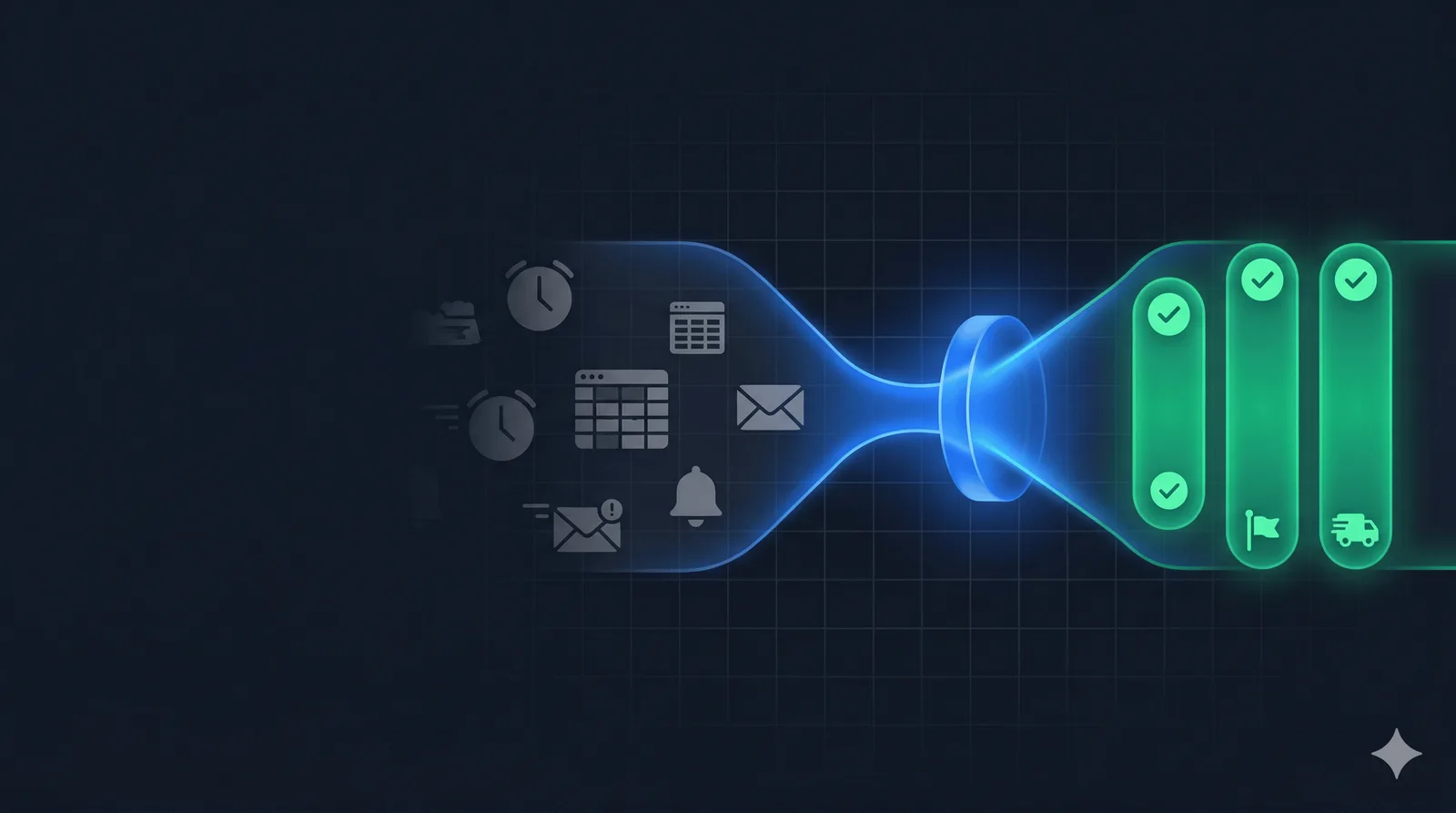
Automation, at its core, means rule-based execution. When X happens, do Y. A meeting ends and a summary gets routed to attendees. A task status changes and a parent item updates. A date is reached and a reminder fires. No intelligence required. No judgement involved. Just reliable sequences that run without anyone having to remember to trigger them.
This is what makes it different from the Assist and Generate pillars. Those are about thinking and producing. Automate is about execution - specifically, the execution of things that were already decided. The rule exists. The process is known. The only variable is whether a human has to manually initiate each instance of it.
The constraint that follows is just as important. Automation handles the predictable. The moment something requires a judgement call - an exception, a conversation that needs context, a stakeholder relationship that needs managing - it steps back. You can automate the reminder. You cannot automate the escalation.
Where AI changes what’s automatable
Traditional automation has a hard requirement: clean inputs. The trigger has to be unambiguous, the data structured, the output format fixed. That’s why the classic PM automations are things like date-triggered reminders or status-change notifications - simple, binary, predictable.
AI removes that constraint. And that matters more than it might first appear.
Take status reporting. The reason it hasn’t been automated before isn’t that the process is complicated - it’s that the inputs are messy. People write status updates in their own words, in varying levels of detail, with different interpretations of what “on track” means. A traditional automation can route that content, but it can’t read it, normalise it, or surface what’s actually worth your attention. AI can. It can take a set of inconsistent, narrative updates from across your project and produce a coherent summary - flagging the items that don’t quite add up, the risks mentioned in passing, the dependency that two people have described differently. That’s not faster admin. That’s a different category of capability.
The same applies to meeting outputs. AI doesn’t just transcribe - it interprets. It distinguishes between a decision that was made and a discussion that was had. It extracts action items from conversational language that was never meant to be structured. It can apply your project’s context to what was said and produce a follow-up that reflects what actually matters, not just what was mentioned.
What this means practically: the boundary of what’s automatable has moved. Things that previously required a person to sit in the middle - reading, interpreting, translating between formats - can now be handled, at least in draft, without that intervention.
The test I use
If I’ve done something the same way three times, I ask: what’s actually stopping this from being automatic?
The signal I look for is low variance - the process barely changes from one instance to the next, only the content does. The who, the what, and the when are stable. Only the data differs. Weekly status report distribution. Action item reminders. Meeting follow-up emails. Updating multiple trackers when a milestone closes. Logging decisions to a register. None of these require professional judgement. All of them require a person to sit down and do them.
A real example - meeting follow-ups
This is the one that gives time back fastest, so it’s worth walking through in full.
The manual version: meeting ends, you take your transcript or notes, draft a summary, extract the actions, paste them into the log, update the meeting record, send the follow-up. Somewhere between 20 and 40 minutes, depending on the meeting. Do that for eight meetings a week and you’ve spent most of a day on admin that isn’t delivery.
The AI-assisted version works in two stages. First, AI does the interpretation: it reads the transcript and produces a structured output - summary, decisions made, actions with owners, items that need follow-up. This is the step that wasn’t possible before. The transcript is unstructured, conversational, and often ambiguous. Turning it into something project-ready required a person. Now it doesn’t, at least not for the first pass.
Second, automation handles the execution: the structured output gets routed - follow-up email to attendees, actions logged to your tracker, meeting record updated. This part is straightforward once the AI has done the interpretation work.
You review before anything sends. That review isn’t a formality. AI will produce something that looks right but occasionally isn’t - a decision captured that was actually still open, an action assigned to the wrong person, a tone that doesn’t fit the relationship. The PM’s checkpoint is the accountability layer that makes the whole thing trustworthy. Without it, you’ve automated something you no longer own. With it, you’ve automated the mechanics while retaining ownership of the outcome.
Setup takes an afternoon. After that, it runs on every meeting of that type until you change it.
The honest limits
Automation, even AI-assisted automation, doesn’t know that the risk sitting green for six weeks should probably be amber by now. It doesn’t know that the status update which looks fine on paper is masking something that needs a conversation. It can surface patterns and flag inconsistencies, but it can’t make the call. Those remain yours.
What it does is clear the decks. When you’re not manually redistributing last week’s meeting notes or chasing the same four people for the same update, you have more capacity for the work that actually needs you - the stakeholder dynamic that’s getting complicated, the scope conversation that’s been avoided, the team member who needs a direct conversation.
The tasks you automate don’t stop mattering. The information still flows, the actions still get logged, the follow-ups still go out. They just stop requiring your hands to make them happen.
Next in this series: Analyse and Interpret - how AI handles the data your project generates, and what that changes about how you make decisions.
Yes, AI helped me to write this :)