AI Is a Brilliant Collaborator - You're Still the Professional
In my last article, I made the case for embracing AI as a project manager. For leaning in, experimenting, and not being the person who stands still while the profession moves forward. I stand by every word of it. But enthusiasm without awareness is how you end up in trouble. And as project managers, we know better than most what happens when teams rush into something powerful without thinking through the risks first. We’ve all seen it - a new tool lands, everyone gets excited, and the governance conversation happens six months later when something goes wrong. So consider this the companion piece. Not a counterargument - a necessary next conversation.
What You Share With AI Needs the Same Scrutiny You’d Apply to Any Risk
Let’s start with the one that most people underestimate: data. When you open a chat window and paste in a stakeholder register, a project budget, or a risk log full of sensitive organisational information - where does that data go? Who sees it? How is it stored, or potentially used in future model training? The honest answer is: it depends entirely on which tool you’re using, and on the terms of service you probably haven’t read in detail. This isn’t a reason to avoid AI. It’s a reason to treat data in AI tools the same way you’d treat any other third-party system - with appropriate scrutiny. Before you paste anything sensitive into a tool, ask yourself: would I be comfortable if this information appeared somewhere outside my organisation? If the answer is no, either anonymise it, summarise it at a level that removes confidential detail, or check whether your organisation has an approved enterprise version with appropriate data protections in place. Project managers are trusted with sensitive information every day. That responsibility doesn’t pause because the tool is new.
Personal Tools and Organisational Tools Are Not the Same Thing
This brings us directly to the tool question - and it’s one a surprising number of people haven’t thought carefully about. Most of the AI tools people are experimenting with personally - ChatGPT, Claude, Gemini, Copilot in various forms - exist in both consumer and enterprise versions. The consumer version and the enterprise version can have very different data handling, privacy, and security profiles. Consumer tools, broadly speaking, are built for individuals. Enterprise tools are built with organisational compliance, data residency, and security requirements in mind. If your organisation doesn’t yet have a policy on AI tool usage, that’s a conversation worth starting - not to slow things down, but to protect yourself and the people you work with. Use personal tools for personal workflows. Use approved enterprise tools for anything that touches organisation or client data. Don’t blur the line. And if you’re in a position of influence - advocate for your organisation to define this clearly. It’s the kind of governance that’s much easier to establish before an incident than after one.
The Output Is Yours. Own It.
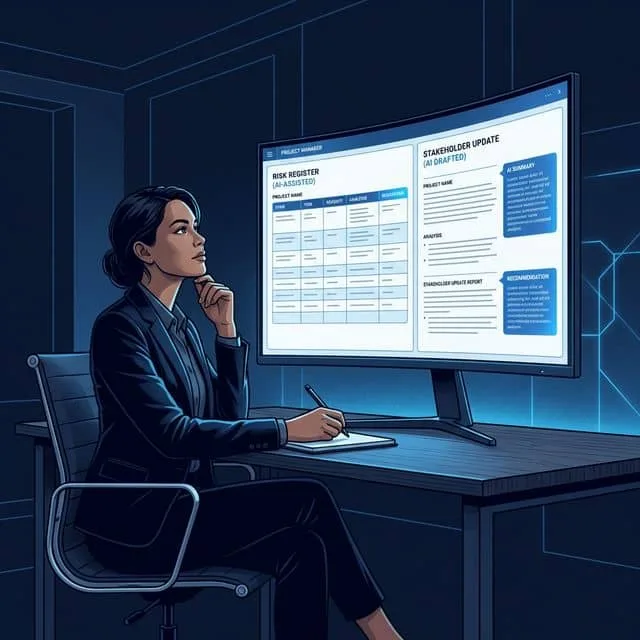
Here’s the one that I think matters most, and that gets talked about the least. When you send a stakeholder update drafted by AI, you are sending a stakeholder update. When you submit a risk register that AI helped you build, you are submitting a risk register. When a project report goes out with your name on it - it is your report, regardless of how much of it was generated by a tool. AI doesn’t have a professional reputation. You do. This means every piece of AI output that leaves your hands needs to go through your judgement first. Not a quick scan - a genuine review. Does this accurately represent the situation? Is the tone right for this stakeholder? Is anything factually wrong, subtly misleading, or simply off? AI can hallucinate details, misread context, or produce output that sounds authoritative but isn’t. These aren’t edge cases. They happen. There’s also an ethical dimension that goes beyond accuracy. How transparent are you being with your team about AI’s role in your work? Are you using it in ways consistent with your organisation’s values and emerging policies? Are you comfortable standing behind everything that’s in the output? These aren’t trick questions - they’re the kind a professional asks before the moment demands it.
The First Draft Is Just the First Draft
One of the most common mistakes I see people making with AI is treating the first output as the finished product. It rarely is. AI output is a starting point - a very fast, often impressive starting point - but it benefits enormously from iteration. Refine the prompt. Push back on what it gives you. Ask it to make the tone more direct, cut the filler, try a different structure. Ask it to steelman a different view, or to challenge its own assumptions. The gap between a first draft and a third draft is often significant, and the tool will get you there if you guide it. Think of it the way you’d think of working with a capable but new team member. Their first attempt is useful. Your feedback makes it better. The collaboration is what produces the result you’re proud of. And as you iterate more, you’ll also get sharper at prompting - which compounds over time. Take ownership of the process, not just the output.
This Is the Worst It Will Ever Be
Here’s the perspective I come back to when I’m frustrated with a tool’s limitations, or wrestling with the complexity of using AI responsibly: what we’re working with today is the floor, not the ceiling. The tools will improve. Enterprise security options will mature. Governance frameworks will catch up. The ethics conversations will get clearer as more organisations work through them in practice. And the skills we’re building right now - prompting well, iterating, applying professional judgement to AI output, knowing when not to use it - these are skills we’ll carry forward as all of that evolves. So don’t wait for perfect. Learn with what you have. Build the habits now. The AI you’re working with today is, in every meaningful sense, the worst it will ever be. The trajectory only goes one way. Make sure you’re moving with it - thoughtfully.
How is your organisation approaching AI governance and tool policy? Have you established guidelines yet, or are you still figuring it out? I’d genuinely love to know where people are at - drop a comment or reach out directly.
Yes, AI helped me to write this :)