AI Agent Governance Charter: A Guide for Project Managers
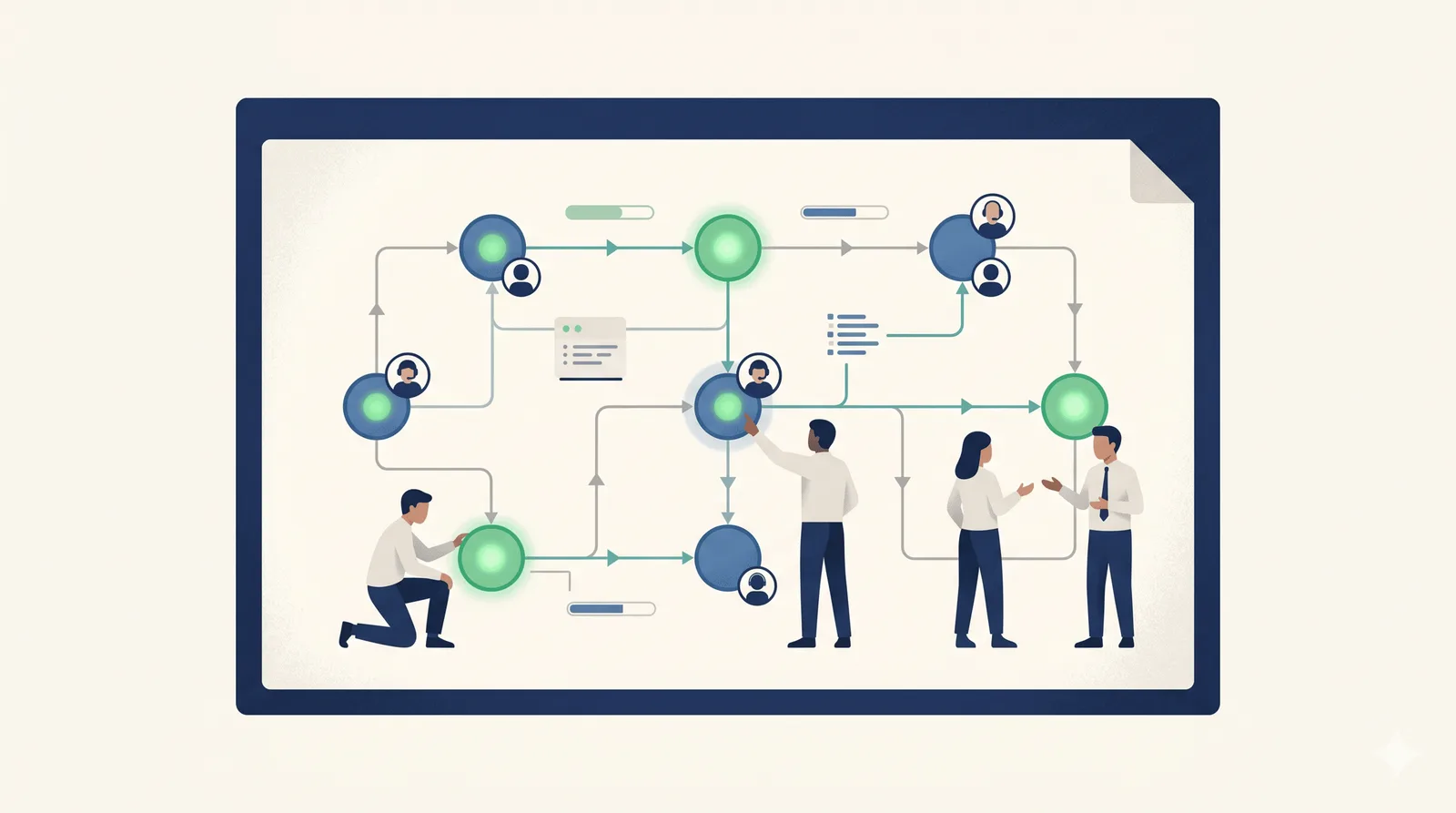
An AI agent governance charter is a one-page document that defines which workflows your team has delegated to AI agents, who reviews the outputs, and what happens when something goes wrong. Most project teams don’t have one - and as agent use spreads across tools and team members, that gap becomes a delivery risk. The fix isn’t complex: a charter can be written in an hour and prevents the kind of quiet agent proliferation that’s hard to unwind once it’s embedded.
There’s a pattern I’m seeing across teams right now that feels familiar - and not in a good way.
Someone connects an AI agent to their project management tool to auto-summarise standups. Someone else builds a Slack bot that chases action item owners. A third team member sets up a scheduled agent that drafts the weekly status report. Each one is a reasonable decision made by a capable professional trying to reduce friction.
Nobody knows what the others have built. Nobody agreed on what should be reviewed before it goes out. And nobody’s thought about what happens when one of them gets it wrong.
We’ve been here before. It’s how shadow IT proliferates. It’s how data quality problems multiply quietly until they’re too embedded to fix cleanly. AI agents are just the latest version of the same story - and the window to get ahead of it is shorter than most teams realise.
Why AI Agents Need Team-Level Governance (Not Just Personal Oversight)
The shift happening right now isn’t about individual productivity. OpenAI’s Workspace Agents, Google’s Gemini layer across Docs, Sheets, and Gmail, Microsoft Copilot running across the M365 stack - these are designed for team coordination, not just personal assistance. Shared bots that operate on schedules, communicate across tools, and work on behalf of the team.
That changes the governance question entirely.
When an AI tool is personal, the failure mode is personal too. You get a bad output, you correct it, you move on. When an agent is operating at the team level - sending comms, updating dashboards, surfacing risk flags, drafting the steering committee pack - a bad output has reach. It affects decisions, stakeholder confidence, and the shared record of the project.
The question isn’t whether to use agents at this level. Most teams already are, or will be within a delivery cycle. The question is whether anyone’s thought about how to govern them.
The PM’s Role in AI Agent Governance
There’s a framing doing the rounds that captures this well: PMs are the bread in an AI sandwich. We own the planning, the prioritisation, and the quality gates. AI handles the production layer in between.
That works cleanly at the task level. It gets complicated when agents are running autonomously on schedules - triggering actions, producing outputs, affecting the shared record of the project - without a human review step built in.
This is a PM problem, not a technical one. Deciding what gets delegated, under what conditions, with what controls, and what gets escalated when something goes wrong - that’s exactly the kind of upfront governance thinking we’re already supposed to be doing for the project itself. We just haven’t been applying it to the agents running inside it.
Deciding What Agents Can Execute - and What Controls Apply
The governance failure in most teams isn’t that they’re using agents for the wrong things. It’s that they haven’t thought through the decision at all. Everything gets treated the same way - which in practice means the conditions get set by whoever built the agent, in the moment they built it, without any shared context.
The charter fixes this by making those decisions explicit. And the decision isn’t a simple stakes spectrum. It’s four questions, each of which shapes what controls are needed.
1. What’s the consequence if the output is wrong?
Not just “high or low stakes” - but specifically what breaks. A poorly formatted meeting summary is embarrassing and easy to fix. An agent that misclassifies a red risk as amber because the prompt wasn’t precise enough is a different problem entirely. The failure mode matters more than a general stakes rating.
2. Is the failure reversible?
Some bad outputs are easy to correct - you catch it, you fix it, you move on. Others trigger a chain: a stakeholder acts on the information, a decision gets recorded, a report becomes the reference point for the next phase. The less reversible the downstream effect, the tighter the control needs to be before the output goes anywhere.
3. Does the task require judgement or just execution?
Purely mechanical tasks - populate this template from this data, flag items that meet this criteria, format this transcript - have clear right answers. Agents handle these well with minimal oversight once they’re well-configured. Tasks that require contextual judgement - is this risk significant given what we know about this stakeholder? does this change request warrant escalation? - are different. The agent can do useful work here, but human oversight stays in place longer, regardless of how the task appears on a stakes scale.
4. How established is this agent in this context?
A well-tested agent running a process it’s handled dozens of times is not the same as a new agent in an unfamiliar workflow. Trust is built through track record, not assumed at setup. The right approach is to start with human review on everything, observe performance, and progressively remove review gates where the agent has earned it - keeping them where the failure cost is too high regardless of track record.
Then set the controls to match.
Once you’ve worked through those four questions for each workflow, the controls become clearer:
- Pre-execution approval - a human signs off on the agent’s inputs or scope before it runs. Use this for novel contexts or high reversibility risk.
- Post-execution spot-check - a human reviews a sample of outputs on a defined schedule. Use this for established agents on mechanical tasks where constant review would defeat the purpose.
- Automated output validation - the agent’s output is checked against defined rules before it lands anywhere (e.g. a risk log entry must include a mitigation owner before it’s written to the register). Use this where the failure mode is specific and checkable.
- Audit logging - every agent action is recorded so you can review what happened if something goes wrong. Use this as a baseline for any agent with consequential outputs, even if no active review step is required.
- Scheduled behaviour review - the agent’s instructions and outputs are reviewed periodically, not just when something breaks. Use this for all agents; the question is frequency.
The charter doesn’t need to specify every technical detail. It needs to record, for each workflow: what the agent is doing, which controls apply, and who owns them. That’s the shared context the team is missing.
What an AI Agent Governance Charter Covers
The concept of an agent governance charter sounds heavier than it needs to be. In practice, it’s a one-page living document that gives the team shared context on how agents are being used, and shared clarity on who’s responsible for what.
At minimum, it should answer four questions:
-
What workflows have we delegated to agents? A plain-language list of what’s running, in which tools, and for what purpose. Not a technical spec - just enough for any team member to understand what’s automated.
-
What are the review and approval touchpoints? For each workflow, where does a human look at the output before it has consequences? Who is that human? What do they check for?
-
How do failures get escalated? When an agent gets something wrong - and it will - who finds out, how quickly, and what’s the process for correcting and updating the agent’s behaviour?
-
How does agent behaviour get updated over time? Agents are configured, not set-and-forget. As the project evolves, the instructions they run on need to evolve too. Who owns that? How often does it get reviewed?
This isn’t a governance framework for the sake of documentation. It’s the shared context that stops agents running unchecked - and stops the team finding out something’s been wrong for three weeks because no one thought to check.
Start Before You Think You Need To
The right time to build the charter is before the agents proliferate - not after you’ve inherited a tangle of automations that nobody fully understands and everyone’s slightly afraid to touch.
If your team has one or two agents running right now, you can write this document in an hour. Map what exists, agree on the review touchpoints, name an owner. That’s the foundation. Everything else is iteration.
If you wait until there are a dozen agents running across tools and team members, the conversation gets harder. The agents are embedded in workflows. People are depending on them. And the first time something goes wrong at scale, the question you’ll be answering isn’t “how do we prevent this?” - it’s “how did we let this happen?”
The teams who get this right won’t necessarily use agents better than everyone else. They’ll just know what they’re running.
What agents are already operating in your team’s workflows right now - and who would notice first if one of them started producing bad output?
Yes, AI helped me to write this :)
Frequently Asked Questions
What is an AI agent governance charter? An AI agent governance charter is a one-page document that records which workflows your team has delegated to AI agents, who reviews outputs before they have consequences, how failures get escalated, and who is responsible for keeping agent behaviour current. It’s not a policy manual - it’s shared context that prevents unchecked agent proliferation.
Why do project managers need an AI agent governance charter? As agents move from personal tools to team infrastructure - running on schedules, sending communications, updating shared dashboards - a mistake by one agent has reach across the whole team. Without a charter, there’s no agreed standard for what gets reviewed, and no clear accountability when something goes wrong. The PM is the natural owner of this because it’s a delivery governance question, not a technical one.
How long does it take to create an AI agent governance charter? If your team has one or two agents running, you can draft a functional charter in about an hour. The document doesn’t need to be long - a simple table mapping each agent to its purpose, its review touchpoint, and its owner is enough to start.
What tasks should project managers delegate to AI agents? The decision isn’t simply about stakes - it’s about four things: the consequence if the output is wrong, whether a bad output is reversible, whether the task requires judgement or just execution, and how much track record the agent has in that specific context. Mechanical, well-defined tasks with correctable failure modes are strong candidates for full agent execution. Tasks involving contextual judgement, irreversible downstream effects, or a new agent need tighter controls - pre-execution approval, spot-checks, or output validation - before you reduce human oversight.